






Copyright © Kaymakanov International.
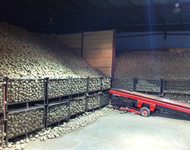
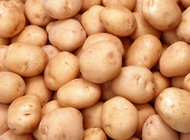
The potato is a starchy, tuberous crop from the perennial Solanum tuberosum of the Solanaceae family (also known as the nightshades). The word potato may refer to the plant itself as well as the edible tuber. In the region of the Andes, there are some other closely related cultivated potato species. Potatoes were first introduced outside the Andes region four centuries ago, and have become an integral part of much of the world's cuisine. It is the world's fourth-largest food crop, following rice, wheat, and maize. Long-term storage of potatoes requires specialised care in cold warehouses.
Wild potato species occur throughout the Americas, from the United States to Uruguay. The potato was originally believed to have been domesticated independently in multiple locations, but later genetic testing of the wide variety of cultivars and wild species proved a single origin for potatoes in the area of present-day southern Peru (from a species in the Solanum brevicaule complex), where they were domesticated 7,000–10,000 years ago. Following centuries of selective breeding, there are now over a thousand different types of potatoes. Of these subspecies, a variety that at one point grew in the Chiloé Archipelago (the potato's south-central Chilean sub-center of origin) left its germplasm on over 99% of the cultivated potatoes worldwide.
Characteristics
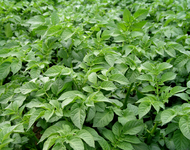
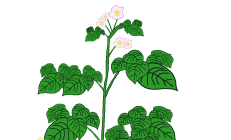
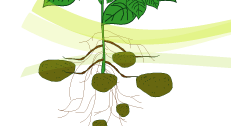
Potato plants are herbaceous perennials that grow about 60 cm (24 in) high, depending on variety, the culms dying back after flowering. They bear white, pink, red, blue, or purple flowers with yellow stamens. In general, the tubers of varieties with white flowers have white skins, while those of varieties with colored flowers tend to have pinkish skins. Potatoes are cross-pollinated mostly by insects, including bumblebees, which carry pollen from other potato plants, but a substantial amount of self-fertilizing occurs as well. Tubers form in response to decreasing day length, although this tendency has been minimized in commercial varieties.
After potato plants flower, some varieties produce small green fruits that resemble green cherry tomatoes, each containing up to 300 true seeds. Potato fruit contains large amounts of the toxic alkaloid solanine and is therefore unsuitable for consumption. All new potato varieties are grown from seeds, also called "true seed" or "botanical seed" to distinguish it from seed tubers. By finely chopping the fruit and soaking it in water, the seeds separate from the flesh by sinking to the bottom after about a day (the remnants of the fruit float). Any potato variety can also be propagated vegetatively by planting tubers, pieces of tubers, cut to include at least one or two eyes, or also by cuttings, a practice used in greenhouses for the production of healthy seed tubers. Some commercial potato varieties do not produce seeds at all (they bear imperfect flowers) and are propagated only from tuber pieces. Confusingly, these tubers or tuber pieces are called "seed potatoes".
Nutrition
The potato contains vitamins and minerals, as well as an assortment of phytochemicals, such as carotenoids and natural phenols. Chlorogenic acid constitutes up to 90% of the potato tuber natural phenols. Others found in potatoes are 4-O-caffeoylquinic acid (crypto-chlorogenic acid), 5-O-caffeoylquinic (neo-chlorogenic acid), 3,4-dicaffeoylquinic and 3,5-dicaffeoylquinic acids. A medium-size 150 g (5.3 oz) potato with the skin provides 27 mg of vitamin C (45% of the Daily Value (DV)), 620 mg of potassium (18% of DV), 0.2 mg vitamin B6 (10% of DV) and trace amounts of thiamin, riboflavin, folate, niacin, magnesium, phosphorus, iron, and zinc. The fiber content of a potato with skin (2 g) is equivalent to that of many whole grain breads, pastas, and cereals.
In terms of nutrition, the potato is best known for its carbohydrate content (approximately 26 grams in a medium potato). The predominant form of this carbohydrate is starch. A small but significant portion
of this starch is resistant to digestion by enzymes in the stomach and small intestine, and so reaches the large intestine essentially intact. This resistant starch is considered to have similar physiological effects and health benefits as fiber: It provides bulk, offers protection against colon cancer, improves glucose tolerance and insulin sensitivity, lowers plasma cholesterol and triglyceride concentrations, increases satiety, and possibly even reduces fat storage. The amount of resistant starch in potatoes depends much on preparation methods. Cooking and then cooling potatoes significantly increases resistant starch. For example, cooked potato starch contains about 7% resistant starch, which increases to about 13% upon cooling.
The cooking method used can significantly impact the nutrient availability of the potato.
Potatoes are often broadly classified as high on the glycemic index (GI) and so are often excluded from the diets of individuals trying to follow a low-GI diet. In fact, the GI of potatoes can vary considerably depending on type (such as red, russet, white, or Prince Edward), origin (where it was grown), preparation methods (i.e., cooking method, whether it is eaten hot or cold, whether it is mashed or cubed or consumed whole, etc.), and with what it is consumed (i.e., the addition of various high-fat or high-protein toppings).
Potatoes are not considered by the NHS as counting towards the five portions of fruit and vegetables diet.
Growth and cultivation
Potato growth has been divided into five phases. During the first phase, sprouts emerge and root growth begins. During the second, photosynthesis begins as the plant develops leaves and branches. New tubers develop during the third phase, which is often (but not always) associated with flowering. Tuber formation halts when soil temperatures reach 80 °F (26.7 °C); hence potatoes are considered a cool-season crop. Tuber bulking occurs during the fourth phase, when the plant begins investing the majority of its resources in its newly formed tubers. At this stage, several factors are critical to yield: optimal soil moisture and temperature, soil nutrient availability and balance, and resistance to pest attacks. The final phase is maturation: The plant canopy dies back, the tuber skins harden, and their sugars convert to starches.
New tubers may arise at the soil surface. Since exposure to light leads to greening of the skins and the development of solanine, growers are interested in covering such tubers. Commercial growers usually address this problem by piling additional soil around the base of the plant as it grows ("hilling", or in British English "earthing up"). An alternative method used by home gardeners and smaller-scale growers involves covering the growing area with organic mulches such as straw or with plastic sheets.
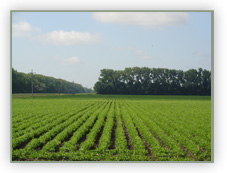
Correct potato husbandry can be an arduous task in some circumstances. Good ground preparation, harrowing, plowing, and rolling are always needed, along with a little grace from the weather and a good source of water. Three successive plowings, with associated harrowing and rolling, are desirable before planting. Eliminating all root-weeds is desirable in potato cultivation. In general, the potatoes themselves are grown from the eyes of another potato and not from seed. Home gardeners often plant a piece of potato with two or three eyes in a hill of mounded soil. Commercial growers plant potatoes as a row crop using seed tubers, young plants or microtubers and may mound the entire row. Seed potato crops are 'rogued' in some countries to eliminate diseased plants or those of a different variety from the seed crop.
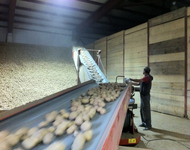
At harvest time, gardeners usually dig up potatoes with a long-handled, three-prong "grape" (or graip), i.e., a spading fork, or a potato hook, which is similar to the graip but with tines at a 90 degree angle to the handle. In larger plots, the plow is the fastest implement for unearthing potatoes. Commercial harvesting is typically done with large potato harvesters, which scoop up the plant and surrounding earth. This is transported up an apron chain consisting of steel links several feet wide, which separates some of the dirt. The chain deposits into an area where further separation occurs. Different designs use different systems at this point. The most complex designs use vine choppers and shakers, along with a blower system or "Flying Willard" to separate the potatoes from the plant. The result is then usually run past workers who continue to sort out plant material, stones, and rotten potatoes before the potatoes are continuously delivered to a wagon or truck. Further inspection and separation occurs when the potatoes are unloaded from the field vehicles and put into storage.